
11 — FABRICATION · 2026
Gift Card Vending Machine
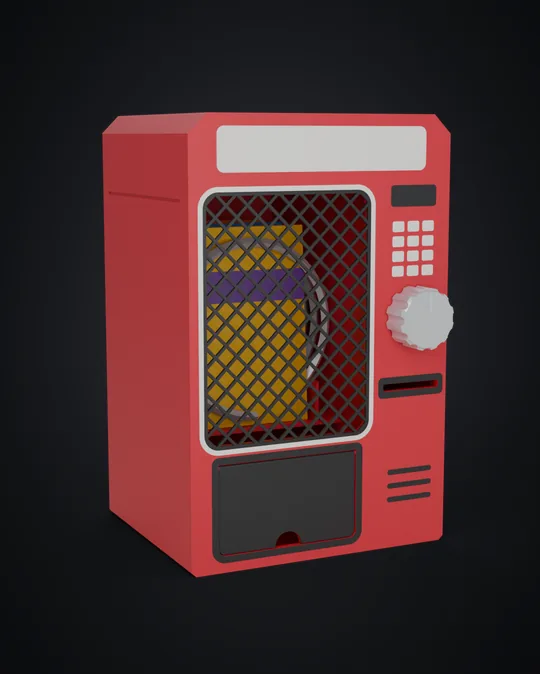
Turn the knob and a real vending spiral walks a gift card forward and drops it in the bin. Eight snap-together parts: no screws, no glue, no support material.
- Built
- A printed vending machine for a gift card, in eight snap-together parts.
- Stack
- CAD in Python, a 3D physics sim of the card drop, a layer checker, a Bambu A1.
- State
- V3 designed and simulated.
IN PROGRESS · UPDATED 23 SEP 2026
The first assembled print showed the cards tipping forward. v3 fixes that in simulation.
Carter Barnes · cloud engineer, federal Azure · Contact

What it is
My first design meant to be a product: a small vending machine for a gift card. Turn the knob and a vending spiral walks the card forward until it drops into the pickup bin.
It holds six cards. Load decoys in front and the real gift card last, and the recipient has to vend their way to it.
It had to print on a home printer with no supports and no hardware, snap together, and work every time someone turns the knob.

How it works
- Size
- 118.8 × 102.5 × 184 mm. Eight snap-together parts on three plates; no screws, glue or magnets.
- Drive
- Knob to a 16-tooth gear, through an idler to a 48-tooth gear on the spiral: three knob turns per vend.
- Spiral
- A diamond-section helix with a 10 mm pitch, mounted low so the card is caught at its top and its bottom.
- Pickup
- An outward-opening door with a sill ramp and a finger notch.
- About 10 hours and 375 g on a Bambu A1. Every color change on the front panel lands in its first six layers.
By the numbers
- 8
- snap-together parts; no screws, glue or magnets
- 3 turns
- of the knob per card
- 3–7 °
- card lean in the v3 spiral, down from 25–30
- 116 of 120
- simulated drops where the old inward flap knocked the card over

What I learned
- 01
Thin things on edge always tip until something stops them
A card on its 0.8 mm edge rides at the maximum lean the mechanism allows. Tightening the pitch barely helped. Catching the card at two heights far apart is what holds it at 3 to 7 degrees.
- 02
Simulate the drop, not just the ride
A 3D physics sim of the card falling showed the original inward flap shoving it onto its far side in 116 of 120 runs. The outward door touches it in none.
- 03
Check the printed footprint, not the face angles
Two faces at 35 degrees can meet in an edge that hangs in air. A layer checker now slices every part at 0.2 mm and compares what will actually print, and it runs on every part I make.
What went wrong
- 01
The spiral failed within minutes
A free-standing helix cannot print standing. It now prints inside a twist-off sleeve that unscrews like a jar lid.
- 02
The cards flopped forward
On the first assembled print the cards leaned 25 to 30 degrees while riding. v3 moved the spiral low and changed its pitch.
- 03
The front panel would not stay on
A 0.4 mm lip minus 0.2 mm clearance left a 0.2 mm catch, and the thin side walls bowed out. Four tapered cantilever latches replaced it.
